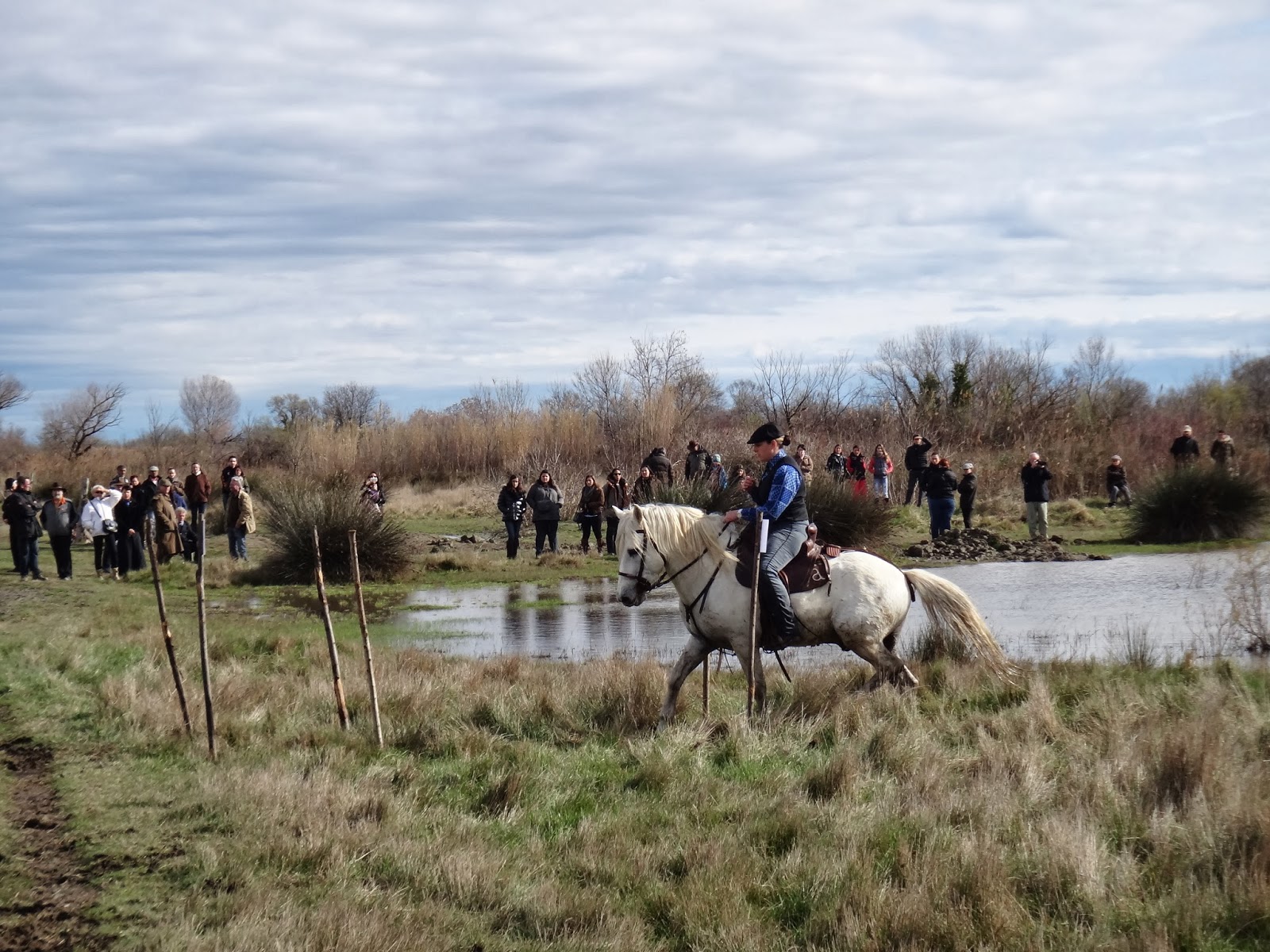
09 March 2014

Patience

…It takes time to develop a horse; it takes time for us, human, to develop into better beings. Amongst others, patience is key.
 
Two weeks have gone by and not much of what I WANTED TO DO and people I WISHED TO MEET had happened. i left my old straight line thinking ways aside, looked on the other bright side of life and tuned in to the Camarguaise ways of doing things and here is what the last week in the Camargue had in store for me: 

i met up with old friends Melanie & Flo and rode again their smooth-feather-light-800kg Rocket on a day’s long ride in the glorious Alpilles. 


Rocket driven by Flo
 ...At the Mas de la Cure, Georges Vlassis, its director, took me a few steps back into the past to better appreciate what this incredible place has to offer today. In the early XIX century, it was a 23,000 hectare property encompassing a third of the Camargue. The domain was a huge collection of farm dwellings (mas), vineyards, arable dry land and marshland on which sheep, bulls and horses would roam. Around 1870, with the signature of a new treaty allowing free trade with the US and Russia and the destruction of all the French and European vineyards by the phylloxera, a ravaging insect, the Mas de la Cure was parcelled off and sold off at auction. In 1893, Mr Noilly-Prat acquired what is now known as Le Mas de la Cure. At the time (time of the Universal Exhibition in Paris featuring La Tour Eiffel) it was a model farm with its own generating electricity facilities, wrought iron structure, own soft water supply, 3,000 Sqm of living quarters accommodating the agricultural workforce, a chapel, stables, a forge, a bakery and its huge 2,000 Sqm of wine cellar. The Vermouth-like wine named after Noilly-Prat, is a fortified beverage which is still commercialised today – Excellent as an aperitif with a few slices of dry cured bull sausage!
Again, the economic climate changed in the late XXst century and the domain was sold in 1985 to the Patrimoine du Littoral and has since become the site for the preservation of the biodiversity of the Camargue as well as the head quarter of the Association for the Camargue horse. A herd of ‘pure’ Camargue horses live in extensive on the property. Mares are donated by established and recognised breeders and stallions from different manades are alternatively used as stud.
Today, George carries forward the vision of Noilly-Prat into the future with commendable determination and enthusiasm. Le Mas de la Cure which is also the backdrop of Camagri stands high in my recommendation of places to visit. http://www.maisonduchevalcamargue.com/

 
The kitchen used to prepare the workforce meals.
From right to left, we can see the sink, the smoke room used to
preserve the meat, the foyer and behind George we can see
the area where the food was kept warm. 
Wine barrels where the superior wine aged... 

...and on the opposite wall, more wine containers for the more
ordinary wine.
One of the building is used as an indoor manège.

...From the Mas de la Cure to Mas d’Estanion i carried on my training in the bulls. There i trained with Gardian Ludo, one of his master cow horse, 20 odd bulls and a few more gardians. Again, the horseman is looking for calmness: calm cows, horse moving calmly and a calm and slow heart bit all around. Cow working is a team work where each participants need to focus on the job. One gardian is in charge of cutting the cow out of the herd whilst others are in charge of guarding the herd as immobile as possible. Position about the cow, position about each other gardians, distances, sensibility of the cow, rating of the horse to the cow, sides on which the cow and the horse put their weight on make the difference with cutting the cow or not. Let alone the style in which it is done! On day two, we cut cows in pairs. Two gardians were cutting one cow out of the herd. The level of complexity shoots up miles. Suddenly, two horses were in the bulls and the pressure on the chosen cow becomes more intense particularly if the two gardians are out of tune with each other. As difficult as it was, i loved every minutes of it! Ludo is a no non-sense excellent trainer which i hope to have the opportunity to train with again.


Job done!
 

...Each year, the Brotherhood of the Gardians meets up over one long day of riding in a hosting manade. There we rode together, acamper (which in Provencal means the gathering of the stock over the range) and finished the day with the unavoidable aperitif, lunch and topical discussion related to the life of the Gardian. 65 horses turned up at Manade Raynaud, our host. Pictures talk for themselves:

 
Victor Mailhan with Stallion Vaillant de Gageron is loaded last with 6 other horses...
 
...then unloaded and ready to ride...

Elodie Mailhan and her dad, Mr Borelli, on Stallion Hogard de Gageron...

Jana


Elodie & Pablo

Silvie

a good looking horse


Raoul & Vaillant


From the left, Elodie, Victor, Mr Borelli on Hoggard, Vaillant...


...and Mars de Gageron, my horse for the day.
This is the kind of place, no one bothers to ask how large the range is as i am not sure anyone really knows (GPS maybe). Facts are that part of the range is flooded by the Rhone and part is by the Mediterranean. Both the river and the sea are miles away from each other. This place calls for freedom in all êtres sensibles. And as all être sensible that i am, my heart sunk to the bottom of my boots when i came across this:  

...glass bottle, plastic, cans, tires, car wheels...everywhere beached by the sea.
To me it makes me think a little bit harder when i run the tap & use my car.
Patience rewarded me with quality time with old friends and eye opening time with new ones... big and small they came in all shapes and sizes...

Jacques Mailhan's 2 years old
 
Stallion a tad higher than my knee at the withers
sporting the colours of the Koniks 


Aunt Marcelle & Uncle Boby in Sanary
Angela & friends
cat & 9 months old Davalan


A chainsaw to work cows a la Colombet
Ruby are you sure you brushed your nails? 
18 hands Trait Du Nord suffering from mud fewer


24 February 2014

Camagri

 
Back amongst the mossies…For those who have been following this journal, they know where i am on the map.

Camagri is the yearly reunion of the bull and horse breeders of the Rhone delta. It is a free entry event for all but strangely enough everybody there seems to know each other. This makes this reunion either very intimate or very clicky, depending where about the circle you are standing.
 
Presentation of the manades participating to the ferrades.
All horses are stallions at stud
 
This three day event celebrates the Camargue equine culture in its splendour. The manadiers bring their best studs, their best three years old for sale and their best riding ponies. Beware to talk about Camargue horses as opposed to ponies to a Camarguais or they may get offended!

Just imagine, three days of endless kissing, black bulls & grey horses everywhere, jumping, Camargue dressage, working equitation, ferrade, cow working and cutting, driving & charging around in the parcours de pays which is the equivalent of the obstacle circuit in Le Trec. All these disciplines except for the driving and the jumping are ridden the Camargue traditional way (one rein ridding) with the traditional gear which is the Camargue saddle & bridle & the seden (this is a get down rope made out of mare’s mane) for the horse. An equally traditional costume is adorned by the guardian consisting of the felt hat or the French beret, the velvet jacket, the tight pant or the skirt as an alternative for the ladies. Flu-like cold is rife in France also which spread is encouraged by all this kissing! How many people were off sick on Monday is anyone’s guess!

Cow working - Guardians waiting their turn to cut the cow out of the herd.
The stallion on the foreground is wearing the seden around the jugular.


Cow working - waiting patiently...


Driving- Bernard Colombet...
...and his three entire 2.5 years old.


Dressage - Marion Fortunet with her stallion Patchak Des Prevots.


Needless to spend too much time saying that everyone there are very proud of their horses and their tradition. During these three days, the horses were ridden and paraded a lot in and out of the arenas. The great majority of them are fit entire horses which are also working horses. They are use to being with other horses and not one fight happened despite close proximity between them. It was a fabulous testimony of traditional horsemanship and savoir-faire.  


Dressage - Christine Aymes with stallion Papet du Colombier. 

Dressage - Papet is wearing the seden as a makeshift halter


The video below is of Angela & Quasar in Maniability or working equitation.


Australian Shepherd puppy...The French love them.
They make close contact with the cows.  
Last but not least, the adrenalin charged Parcours de Pays...
...

...hang on to your hat...


...

16 February 2014

Przewalski Horses


...With my saddle & the two dogs packed in the back of the car, i left for France in search of few more experiences and dryer weather...

Worldwide there exist 7 species of wild equine spread between Asia and Africa. 
Of these 7 species, Equus Kiang and the Equus Quagga, also known as the Zebra of the Southern African plains, are not in danger of extinction. However, the Equus Grevyi (Zebra of Grevy), the Equus Zebra (Zebra of the mountains), the Equus Africanus (The wild donkey of Africa), the Equus Hemionus & last but not least the Equus Ferus Przewalski, also known as the horse of Przewalski, are all endangered species.

On my way to the Camargue, i stopped over to the Cause Mejean, a calcareous plateau of the National Park of the Cevennes, situated in the South tip end of the Massif Central. There, i observed the critically endangered horse of Przewalsky. Today only 1,872 Przewalsky remain worldwide. They have been extinct in the wild from 1970 to 2008. In 2008 a few selected ones have been reintroduced to the wild thanks to TAKH, the association for the horse of Przewalski. Although the majority of Przewalski are seen in small paddock in Zoos, it is in the French reserve of the Cevennes that 40 Przewalskis are let to breed as close to their natural habitat as possible. The aim of this program is to release them into the wilderness of Mongolia in Central Asia. The TAKH program is let by scientist Claudia Feh.
  
...In the Cevennes National Park...
 
...on my way...
 
...to the...


...Causse Mejean, a calcareous plateau.
The objectives of the project is to as much saving the Przewalski
as to preserve the natural habitat of the Causse Mejean. 

The grazed grassland of the Causse harbours a typical and rare flaura
and fauna of the continental steppes.  
Yellow Pheasant's eyes, Adonis Vernalis, Alpine Aster, feather grass,
Stippa pennata, Little Bustard, Tetrax, Stone Curlew, Burinus oedicnemus,
Hoopoe, Upupa epops, Griffon & Black Vultures, Gyps fulvus & Aegypius monachus,
Golden Eagles & Aquila chrysaetos.   


Axle & Ruby


A lone male is looking at us

Przewalski is a wild horse and should not be mistaken with feral horses such as the Mustangs and Brumbies. 
Mustangs were domesticated horses turned loose and consequently returned to their wild self. The Mustang belongs to the specie of the Equus Caballus. 
The Przewalski has never been successfully domesticated and therefore never been ridden. It is a truly wild horse of CentralAsia which is also believed to have lived in Europe during the ice age about 10,000 years ago (see Lascaux fresco). The Przewalski horse belongs to the specie of the Equus Ferus Przewalski. 
The Przewalski has 66 chromosomes, 2 more chromosomes than the domesticated horse (Equus Caballus) including the Mongol pony such as the one Genghis Khan used to ride. Hybrids (Caballus X Ferus) can have 66, 65 or 64 chromosomes and are fertile. 
Although a couple of chromosomes does not change the composition of their genes, they change their disposition. Przewalski horses shed the hair in their manes and tails each spring hence the Mohican-like mane they tend to have. This should not be mistaken with the Fjord pony whose mane is often cut short to look spiky ressembling the mane of a Przewalski.  

Twice, over two days i had the chance to observe these 40 horses. As the aim of the stud is to release the horses to Mongolia, the reserve has for policy to keep the horses as far away from human contact as possible. With a pair of binoculars i walked alongside the fenced perimeter of the 1,000 acres reserve and was lucky enough to catch a glimpse of the various groups. i was accompanied by the head Ranger there who was kind enough to discuss the dynamic of the herd beforehand. 

Currently there are 6 bands; 3 headed by one alpha stallion each and 3 small bands of bachelors. i observed similar behaviours as those of the Koniks at Wicken Fen in Cambridgeshire where i live. The similar behaviours were: all grazing or all resting in the direction of the blowing wind; self-grooming & scratching against rocks and so on. At one stage i walked a few steps towards them and half of them bolted. On the second day i observed a lone male bachelor which was resting but once it saw me it became very curious and agitated. In both instances i was very far away from them. Their behaviours showed that their sense of preservation (and most certainly their lack of contact with human) is very strong.

In 2004, 12 horses from France were flown to Mongolia and released. One year later, 10 others joined them. They now leave in Mongolia over 34,000 acres. They still live together as family groups as initially established in France. In 2008, 5 foals were born and as of today there are no more plans to transport any more horses from France to Mongolia. The French Przewalski are kept as a population reservoir able to intervene in case something catastrophic should happen to the ones already reintroduced to Mongolia. For more information on this important and fascinating project consult www.takh.org which is translated in French, English and Mongolian.


TAKH means wild horse in Mongolian.
 

Thank you to Mrs Feh and to the whole team at TAKH for your huge conservation effort (and for having me).