13 January 2022

Riding The Peddar's Way

    A friend suggested i should record my 4-day trek on the Peddar’s Way à la Tschiffely. i am not so immodest as to compare riding 80kms in flat Norfolk with riding 10,000 miles from Argentina to New York in 2.5 years, but i can draw his inspiration!

My horse, Autan, and i travelled on the old Roman road of the Peddar’s Way at the beginning of January 2022.

    The remark most often expressed by my fellow riders is that January is cold and therefore uninviting. Most riders seem to have written January off. How can this be possible? For me January is the perfect month to ride out.  No-one ventures out except for hardy outdoor lovers, dedicated dog owners, bambis, pheasants, foxes, geese and hares, all of which i find excellent company.  The cold weather is exhilarating. It whips you for the first few minutes but then kisses you warmly all over as you and your horse get moving.  In January, the sun shines often and it rains far less than in August in the UK.  Last but not least, those who let you have a stable for a tired horse in the middle of winter, are people worth riding out to meet. They have been, without exception, outstanding hosts and i am glad to have saddled up.

Flock of geese in inverted V formation.
For safety, this is the shape riders should form when 3 or more horses travel on the road. 

     It was my third time riding the Peddar’s Way in January but it was the first time riding alone with my horse. Riding alone versus riding with others is a different ball game altogether. And, in my opinion, often a better one. Over the years i have heard my mentor say that a horse that does not back up well is guaranteed to not do well at everything else. Along the same line of experience, riding with people who are consistently poor at time keeping are guaranteed to be balls and chains along the way. Choosing whom to trek with requires careful consideration.

    Trekking starts with a mental & a physical effort but on day 3 or 4, horse and rider change mode. A switch happens and it feels like everybody is managing better and everything is balancing itself out.  It is worth trekking for four days, at least, to notice this switch. For Autan & me, it happened on the third day. The further you ride, the freer you become. Furthermore, the Way makes you happy.

    Trekking is discovering how much you trust your horse and how far he trusts you back. This is an integral part of trekking. Pretty soon, you do not need to tie your horse up when you stop for lunch. In the saddle, one follows the other and wise versa.

This was during a lunch break. Autan could have gone anywhere he liked. Yet, he stayed by me.
i walked away a few steps and he followed a few steps.
Then, Autan & i carried on each with our lunch.
Lovely feeling!

    On a more practical side of trekking, the following are prerequisites ~ Make sure your horse ties up confidently alone ~ Make sure you have a few knots in your repertoire to tie your horse safely & not to damage the saddlery when doing so. i have four knots i do regularly so that i don’t forget them. They are the half-hitch knot, the bow line knot, the bank robber knot & the Buckaroo square knot to tie up my scarf neatly ~ Horse and rider wear reflective gear. It is guaranteed to cramp your style but on UK roads it is essential for the safety of all involved ~ And fourthly, ride with an open mind as you will need it when you arrive at your daily destination.

Here Autan is tied up using 3 knots.
The horseman bridle becomes a halter when knotting a half-hitch & a bow line.
If the horse were to pull, this knot combination prevents forces exerted on the bit.
The third knot used is the Bank Robber knot to tie the horse to the stable bars.

Day 1 – 14kms in 3hrs  We started in Wretham. On the first day of the trek, there is often this desire to hit the road fast and furious. i don’t. Instead, we rode all the way at the walk; slow, medium, fast, collected and elongated walks under a frosty and sunny winter day. Autan met a llama for the first time. It was a stand off between them. Both head-high, they looked at each other like two statues in Le Jardin Des Tuileries.
Silvery start with frost underfoot.

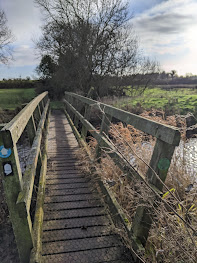
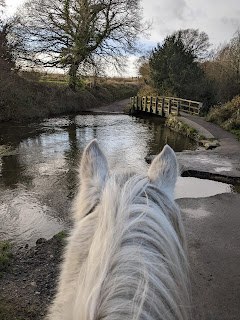
Day 2 – 22kms in 4hrs30  This section of the Peddar’s Way is mainly tarmac and being a Roman road, it goes in a straight Northerly fashion. This is perfect for dressage exercises. There were a few obstacles along the way in the shape of kissing gates, a very narrow bridge and a knee-high ford. The sun shone for us all day.


Day 3 – 14kms in 1hr50  Being a short ride & off-road all the way, the intention was to go for speed. Under heavy rain and strong wind, off we went and we loved it! It was a smooth ride by judging at the unbroken state of two eggs i carried in my saddle bag.

This ride was dedicated to Olivier Faure, a French horseman friend, who left us. 


Day 4 – 29kms in 4hrs20  Autan was dancing & prancing in his stable ready to go. This is the day where everything comes together, weather wise too. It was another crisp and sunny day. We reached the North Sea at 1.30pm at Holme-Next-The-Sea. We closed our ride with cantering the infinity symbol on the beach. Aaahhh! Corny i know but nonetheless this is what we did.


In all, we rode 80kms in four consecutive days in the glorious Norfolk countryside.

21 December 2016

Riding with Master Horseman Mike Bridges


Mike riding 16 year old Dusty

Mike Bridges is an internationally renown California-style Vaquero horseman-stockman who has made a living for over 60 years on the back of a horse. His deep understanding of biomechanics in horses as well as humans makes him a clear and precise teacher. He is able to look at a horse’s movement and correct the rider’s position and technique. i first met Mike in 2009 but it is only in his latest UK clinic, Seeking Refinement, in November 2016 that i was able to ride under his instructions.
i refer to individuals like Mike as individuals with a true level of meditation on the subject they teach. True meditative state is very real. It includes sincere enthusiasm which leads to ever-seeking knowledge through many years of experience establishing a solid understanding of what works and what does not.
When i  asked Mike where home is for him when back in the States, is answer was simple. ‘My home is where I park my lorry.’ Mike teaches all over the world but whilst in the States he travels with his 4 horses: An 8 year old, a 4 year old, a 3 year old and a 2 year old. ‘They are all brothers’ said Mike.


The following is a synopsis of what i learnt during this superb clinic with Mike.
A good cow horse
In the introduction section of his book The Art of Making a California-Style Vaquero Bridle Horse, Mike writes:

The Vaquero-style bridle horse is one that is ridden in one hand for all work, and controlled without fingers through the reins. His primary job is to handle cattle, which includes herding, driving, cutting and sorting in a gate. In the roping of cattle, he serves as the engine to pull or as the anchor to hold. At all times, he should be a pleasure to ride.

A bridle horse should be very light in the face and throughout the body, being obedient to the slightest of signals from the rider. It takes 5 to 8 years to build what Vaqueros call a ‘straight up bridle horse’. This time is necessary to build the strength throughout the horse’s back and the rest of his body so he is able to work in a collected frame for long periods of time.
It is the training that makes the bridle horse, not the pedigree or type. When you see one is like watching poetry in motion in its movements, with lightning response to the rider’s demands.’

i asked Mike what, in his opinion, makes a good cow horse? A horse which is receptive to the slightest movements, he answered. The rest is good training.


Leg of the rider & its influence on the horse’s vertebra
The lower part of the leg below the rider’s knee influences the 15th , 16th, 17th & 18th thoracic vertebras whereas the upper part of the rider’s leg influences the 14th and the forward thoracic vertebras towards the neck of the horse.
The 14th thoracic vertebra is situated approximately under the middle of the saddle seat.

Weight distribution
Almost always put the weight slightly in the sense of direction you are going. For example, if trotting to the right, the weight should be slightly heavier on the right cheek. There is an exemption for canter departure. In canter departure, we put more weight in the opposite side of the departure. For example for a right canter depart, put a tad more weight on the left cheek.    
The Shoulder-in
The shoulder-in is a lateral movement working on the suppleness and balance of the horse by engaging the hind quarters and loosening the shoulders. The horse travels on 3 tracks where the inside hind leg and outside fore leg are on the same track. The horse has a slight bend in the neck bending around the inside rider’s leg.
In Shoulder-in, my inside leg is asking two things. a) create the bend of my horse about the 14th vertebrae further & b) to place (in the case of a cow horse) or hold (in classical dressage) the hind quarters on the track. Always aiming at lessening the cue and once the horse travels as asked relax the leg. The outside leg drives the horse forward.
My outside rein acts as the wall. It must be still and strong but it softens once the horse is in place. My inside rein is loose creating the bend by letting the inside shoulder in.
I am sitting straight in the saddle.

In shoulder-in, once the horse is engaged, the front end lightens and so do the reins. Be aware of the balance of the horse and the evenness of the reins.

The Shoulder-out
is the reverse of the shoulder-in.


The Leg-yield ( La session in French)
The leg-yield is a lateral movement in which the horse travels forward and sideways looking in the opposite side of travel. His spine is straight but his pole and jaw are looking away from the direction of travel. The horse’s inside fore crosses in front of the outside fore leg.
On the R rein, the horse yields to my L leg. My R leg and R rein are open allowing the horse to move sideways. My L rein incites a L flexion away from a R travel.


The reason the leg-yield is easier than the half-pass is because it is easier for the horse to find balance whilst traveling in one direction and looking in the opposite direction.

Exercise – Shoulder-out, leg yield, turn around, small circle At the trot, shoulder-out then leg-yield then leg-yield at the walk then turn-around then leg-yield at the trot then leg-yield at the walk then small circle.

The Half-pass (L'appuye in French)
The half-pass is the same as the leg-yield except that the horse is looking in the direction of travel.
On the R rein, my R rein establishes the R flexion.
The half-pass is a more difficult exercise for the horse than the leg-yield.


The Trot
Straight or other ways look for the stillness of the horse's head. The more engage the horse, the stiller the head is. Put feel in each finger but keep the hands still.
Almost Pas De Deux with Clare riding Rebel
Turn & Stop
A reining horse turns & stops but a cow horse never turns & stops. A cow horse turns and go somewhere. A stop only takes place from a walk. Don’t trot and turn. Walk and turn.
How far do we want the horse to look into the turn? We want the horse to look inside the turn but not too much. Whilst turning the horse’s outside fore crosses in front of the inside fore.


As a schooling tip, Mike reminded us to work on our back-up often and regularly. First you want distance and fluid steps and it does not need to be straight. The fluidness of the steps is very important as that develops along with the distance it will be easy to straighten the horse later. Do not try for speed until the horse can back straight with balance. As the back-up improves the balance of your canter will improve and your stops will get better!


Responsiveness
An analogy Mike gave regarding what he is looking in terms of responsiveness from his horses. When the phone rings, says Mike ‘I expect my horse to answer the phone not to listen to the phone ring’.


Exercise 1 – Shoulder-out, Leg yield, trot, canter
At the trot – K to V , Shoulder-out – V x R, Leg yield – R to M, straight trot – L Canter at M
Exercise 2 – Shoulder-out, half-pass, trot, canter
At the trot – K to V , Shoulder-out – V x R, Half-pass – R to M, straight trot – L Canter at M
Exercise 3 – Shoulder-out, Leg-yield or half-pass, Shoulder-in
At the trot – K to V, shoulder-out – V x R, Leg-yield or Half-pass – at R, shoulder-in
Exercise 4 – Mixing Shoulder-in, Bends, Walk & Trot
Walking or trotting on the L rein – B to M, Shoulder-in – At M create a wall with my R rein and R leg and drive the L hind with my inside leg – Just past the corner, I aim to be in the same shoulder-in position as I was before taking the corner – Trot shoulder-in up to the next corner, keeping the shoulder-in positon – Past the corner, I should be in shoulder-in again – H to E, shoulder-in.


Up & down transitions looking for lightness
6 strides of canter – a few strides at the walk – 6 strides of canter – walk and so on. We are looking for smoothness and connection. The horse is collected. This is not a lope. We are looking for lightness in response and lightness in movement. Once these two are achieved, a horse becomes light. Beware that the first canter feels good but the subsequent ones feels heavy as the horse is falling on his shoulders.
Counter-bent circle
On the L hand circle, the horses head bends to the R – Take the outside rein to the horse’s R shoulder so that the horse’s shoulder can move – Drive with the outside leg – The inside leg stays neutral.
Then travel straight, then change hand.

Back Bone Stop
This is a good stop to learn particularly for reining and cow horses. The idea is to teach the horse the stop cue with the help of the cavalleti. Once the horse recognizes the cue, the cavalleti is not necessary anymore. The aim is to have a neat and immediate stop to the cue.
Start by trotting or cantering your horse around going over a cavalleti for about 20 times.
A length away from the pole, I hardened my hands without pulling on the reins, rotate my pelvis as if I am bearing my spine in the ground. If the horse stops, let him rest for 20 second then take him away without crossing the pole. If, however, he does not stop on cue and crosses the pole, turn him around and rush him back to the starting position and repeat the exercise.

Autan's 1st ride in the hackamore
If there is one horseman to ask for guidance, it is Mike. He is the expect of the hackamore. On the 3 last days of the clinic, Autan was in the hackamore. Throughout the clinic, Mike and Marci helped me a lot with my hand and finger positions as well as feeling the horse through the mecate reins. Autan responded very well despite having not ridden in the hackamore for 3 years.


One of the reason Mike’s clinic was such a success for me is because the improvement in my riding was immediate. The feel i got from my pony was instantly lighter and better. i would recommend anyone who seeks improvement and refinement to ride with Mike. 

Marci, Mike, cat & Autan


15 September 2016

Power & Care with His Holiness The Dalai Lama


It was in Brussels during the 31st Mind & Life conference that i went to listen to world experts in the fields of natural science, anthropology, psychology, ethology, ecology, endocrinology, neuro-science, economics and the world’s contemplative traditions talking about POWER & CARE.

The panel of speakers was of the highest order. It was refreshing to listen to well researched speakers as opposed to gobbledygook based on Google search from people who tap into their friend’s emotions as a reliable source of information.

‘’One of the great problems of history is that the concepts of love and power have usually been contrasted as opposites, polar opposites (…) Power at its best is love implementing the demands of justice, and justice at its best is power correcting everything that stands against love.’’ So said Martin Luther King Jr. in August 1967.
*
Professor Frans B.M. De Waal, PH.D. (Prof. of Psychology in Emory University, USA; Director of Living Links Centre at the Yerkes National Primate Research Centre in Emory University, USA; Distinguished Professor, University of Utrecht, The Netherlands; Biologist & Primatologist) who has been studying chimpanzees for many decades started the dialogue talking about chimp politics.

In chimp politics, power emerges through body language in the same way it emerges in humans. From an ethological perspective, there are no differences between the body language of primates and humans.

Prof. De Waal defines empathy as the ability to understand and share the feelings of another being.
In a short film, we see a female chimp bite a baby chimp. The baby screams and cries of pain until the alpha chimp comes to console it. Consolation is an act of empathy. Further studies have shown that in chimps and human alike, the level of empathy is lower in orphans than individuals who have been mother-reared.

From a power & care viewpoint, alpha males are a protector of the weak. They will stop two babies fighting; if not, their mothers will start fighting. Subsequently, alpha males are also the first provider of consolation making them peace-makers-in-chief and consolers-in-chief. The neuroscience in rodents and primates is similar to the neuro-science in humans hence this is also true in humans.

In another experiment, two alpha males live together. In moments of crisis, we observe that both males resolve conflict quicker when they are mutually dependent on food. So mutual dependency increases prevention of conflict and war. On that very point of the dialogue, Prof De Waal mentioned NATO. After the 2nd world war, the EU (NATO was created by the EU) was created out of mutual-dependency initially between France and Germany to prevent a 3rd WW happening. This is a profound basic understanding which the UK has failed to understand. After this explanation, the audience applauded somehow in pity, agreement and disbelief


Body language anyone!
Following from this perspective, His Holiness added: Buddha encouraged people not to take his words for the truth. He invites investigation, scepticism and open mindedness. We have just seen with chimps that love, consolation and empathy bring peace. This has nothing to do with religion. Human beings are weak physically compared to lions and elephants and yet they start wars due to ill-mindedness and lack of empathy.
*
Professor EM. Sarah Blaffer HRDY (Prof. emerita, university of California-Davis, USA; Anthropologist) carried on the dialogue from an evolutionary anthropological perspective.

When a baby chimp is born, its mother holds it tight and always close to her for the first 6 months of its life. With human birth however, the scenario is different. A human baby will be handled from birth by an array of different people as well as by the mother. The mid-wife, the father of the child, the siblings, other members of the family and friends will all be given the opportunity to hold and interfere with the baby. This has to do with the trust the mother has for other caretakers. The chimp female has none whilst the woman has some, in some cases a lot. From an evolutionary view point, children who have been subjected to most care by different caretakers by the age of 1 will have an increased likelihood of survival beyond the age of 3. And just as a side note, it takes 13 million calories to raise a child until he/she can produce as much as he/she can take.

Furthermore, having a multitude of caregivers in childhood is correlated with an enhanced capacity to take into account multiple perspectives later on in adulthood. Multiple perspectives increase cognitive development. Over generations these children will be favoured by Darwin’s evolutionary concepts.

In terms of brain sizes, 2 million years ago, the brain of a chimp was 450cc. Later on, the Homo Erectus’s brain grew to 900cc. The Homo Sapiens’s brain of today measures 1,500 cc. From a survival and evolutionary perspective, relying on mothers and women are of upmost importance.

But fathers are also sensitive to childcare. Caring fathers show psychological changes in their behaviours. From an endocrinological perspective, changes in hormone production occur also. In caring fathers, the level of prolactin (hormone best known, usually in women, for producing milk) increases, testosterone level decreases and the level of oxytocin (social bonding hormone, usually associated with sexual reproduction, childbirth & breast feeding) increases.

A change in hormones also occurs when allo-parenting (eg. Grand-parenting).

In this dialogue, Prof. Blaffer, showed that women have immense power in the way we ultimately care from one to another, that major changes in hormone production occur whilst caring for one another, that care is a major contributor to the growth in human brains and last but not least that testosterone can also play a role in the display of greater caring behaviour. Powerful stuff!

Prof. Blaffer lives in California where she and her husband combine
habitat restoration and growing walnuts.

*

Prof. Johan Rockstrom (Executive Director, Stockholm Resillience (Resilience) Center; Prof. in Environmental Science, Stockholm University, Sweden) is an internationally recognized scientist on global sustainability issues.


First and foremost, Prof. Rockstrom started his dialogue by saying that His Holiness’s call for power and care has a strong scientific support.


We have wrongly based our assumption that we are a small world living on a big planet. We have entered the age of anthropocene. Anthropocene denotes the current geological age viewed as the period during which human activity has become the dominant influence on the environment and this denotation is built on facts:
-Up to 1990, we saw no major changes to our environment. Since then we see massive changes occurring under our eyes. i won’t enumerate them here because we all know them. But next time you hear someone say that global warming is a fantasy just fall on them like a ton of bricks!
-Exponential rise in killing living organism (vegetation & sentient beings)
            -Great acceleration of species extinction
-We have reached a 3 degree Celcius variation in the ambient temperature. Despite the Climate Change Convention of Paris advocating a 2C variation, scientific studies show that an harmonious stable planet depends on no more than a 1C variation

His Holiness’s message has long been speaking of respect for our environment. One small change in the way each of us go about using natural resources may make a small difference at the end of the day but a difference none the less. But a daily small difference for the rest of our lives would make a huge difference. Moreover, we will teach others by our good action and a snowball effect will touch the 7 billon of us on this planet to practise power and care.
Professor Dr Alexandra M. Freund (Prof. of Psychology, University of Zurich, Switzerland) spoke from a motivational psychological perspective explaining that humans are equipped with different ‘motives’ that influence our behaviour and interaction with others. It is necessary to apply power to create these motives.

When we think of people of power, we often think of negative power (Hitler) but less often of people of positive power (Gandhi). Let’s look at what happens when we assign power to people.

The dark/negative sides of power are: less attention are paid to others, decreased consideration of other’s perspectives, increase in objectivisation of others and using others as a mean to achieve one’s goal, increased corruption, decreased willingness to help others, decreased trust & increased cynicism and decreased desire for inter-personal harmony.

The bright/positive sides of power are: less stress, increased social resilience after exclusion, increased ability to infer others’ thoughts and feelings, increase in social network, increased subjective well-being, decreased loneliness, fosters authenticity and therefore increases happiness. And finally, power can increase altruism and care for others.

Prof. Freund went on to say that part of our problem is if we see ourselves as powerless and insignificant we will give up on the idea of caring, altruism and compassion.
Nelson Mandela

Mahatma Gandhi
*
The dialogue carried on with Professor DR Markus Heinrichs (Dept of Psychology, Laboratory for Biological and Personality Psychology, Freiburg Brain Imaging Center, University of Freiburg, Germany) ‘s perspective on the biology of care and social hormones.

The hormones most associated with care and power are oxytocin and testosterone respectively.
The production of oxytocin in babies starts in the baby’s brain. It then passes into the baby’s blood stream allowing milk extraction. Oxytocin increases eye contact, trust, control of stress and social interaction. Further research also suggests that oxytocin fosters altruism only towards in-group members. Hence parents who can produce higher level of oxytocin increase their ability to care for their own children.
Cortisol is the hormone associated with stress. Let’s look at different scenarios triggering the production of cortisol in men and women. The following is hilarious! And in my case, it has brought a new level of understanding to the reasons why i tend to leave my husband at home where i know stress will be part of an event i am going to.

The bar chart below shows what happens to the cortisol's production when men and women enter a room for a test.
Scenario 1 - When alone & under stress, a man produces more cortisol than a woman.
Scenario 2 - Each individual is allowed to bring a person of the opposite sex with them in the room for support. For both they stress less therefore the cortisol is less. The cortisol for the man is still higher than for the woman.
Scenario 3  - Each individual is allowed to bring their spouses!!!!!!!(assuming heterosexual couple) 

The graph above is called the 'touch effect' where the cortisol level is monitored when a woman is under stress.
The red line shows the cortisol distribution when a woman is under stress and she is alone.
The grey line shows the cortisol distribution when the woman is supported by her husband in a verbal manner! Oooops
The blue line shows the cortisol distribution when the woman is supported by her husband. But this time the husband gives a neck massage and he is quiet! 

I laugh then and i am still laughing out loud now!!!!
*
Professor DR Tania Singer (Director, Department of Social Neuroscience, Max Planck Institute for Human Cognitive and Brain Science, Leipzig, Germany) talked about data based on the concept of plasticity.

Recent findings in neuroscience have suggested that altruism and compassion can be developed through brain plasticity (malleability is another word to explain) and increase pro-social behaviour.
To state the obvious, training practices change the way we think. To live a life without training the grey matter does not increase compassion. Becoming wiser by the pure fact of growing older does not happen. All of us who own horses and who are seriously active in understanding them know that time on an untrained horse gives you just the same green horse just older.
*
Prof. Richard C. Schwartz, PH.D. (Developer of the Internal Family Systems Model, Teaching Associate, Department of Psychiatry, Harward (Harvard) Medical School, USA) explains that each of us strive for power, have a tendency to think of ourselves first, to get others to do what we want and to accumulate money and material things to feel proud and safe. We also have a tendency to care for others and to even put their interests ahead of our own urging us to be collaborative, helpful and well liked. Both impulses are valued assets when they are balanced.

From a psychological perspective, power and care can come closer to each other. The person we care for is not totally powerless as they can refuse help. In the same way the alpha member needs to care for others in order to keep his position. Consequently, separating power and care would be artificial.
It is also safe to say that the relationship between those two impulses does not follow a simple distribution.
*
In this following session, we heard the perspective of power & care from the spiritual and religious tradition.

Matthieu Ricard, PH.D. (Buddhist monk, photographer, humanitarian and author) spoke about Buddhism.
The essence of Buddhism is the relation between wisdom and compassion. Once those two are solidly established, we can start thinking of power.
Bodhicitta is the attainment of enlightenment to help all sentient beings. Power is used as a tool never for greed, never for revenge or for jealousy but for wisdom and compassion. Non-violence is never seen as a sign of weakness. Non-violence towards other human beings, animals and the environment is a sign of power. This is not to say that we must be passive in front of conflict such as war, genocide, attack etc. Of course we do something! We extinguish the spark earlier as oppose to the inferno later. In Buddhism there are NO EXCUSES for the use of violence to kill. None!
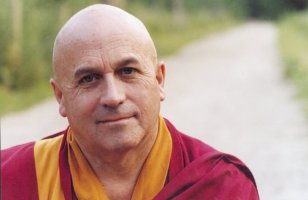
Matthieu Ricard
*
Rabbi Awraham Soetendorp (Founder and President, Jacob Soetendrop Institute for Human Values, The Netherlands) spoke with so much poetry it left me and the 2,000 other people, given the ovation of the audience at the end, speechless. Below are just a few of the words Rabbi Awraham delivered:
‘‘Your Holiness, my brother, my long-time friend…we desperately need each other to achieve a common goal…you are so right in pointing in the unity for the harmony…in my life, inter relations between tradition have saved my life…he who saves one human being saves the whole world regardless of religion, colour, race, sexual inclination…we are all temporary residents on this earth …we must be more powerful always driven by care.’’  

Rabbi Awraham Soetendrop
*
It was the turn of equally humbled and impressive Brother Thierry-Marie Coureau, O.P. (Dean of the Theologicum – Falculty (Faculty) of Theology and Religious Studies, Institut Catholique de Paris, France; A former Engineer and financial officer, he joined the Dominican Order in 1990. He presented his thesis on the study of the three Bhanavakrama of Kamalashila in 2004. Before teaching at the current institute he spent one year travelling in Buddhist regions to learn Buddhism) to talk about power & care.

Very pragmatically he said that we do not need any new ideas for the world because we have them all already. We need to implement them. When, as a Father, we gain authority, people give us power. Caring is listening to others. Today, the world needs listening not to be spoken to. Some people need to be listened to. We also decide to love and not to wait for reciprocity because once you love there is nothing else. It is done!
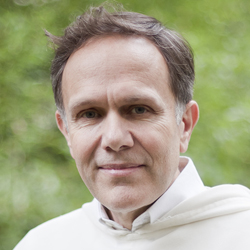
Brother Thierry-Marie Coureau
*
In this next session of the conference, we heard from Economists, advisers to governments, Monetary Fund Developers in third world countries, artists & another Novel Peace Prize winner in addition to His Holiness.

Prof. Dennis Snower, PH.D. (President, Kiel Institude for The World Economy, Germany; Prof. of Economics, Uni of Kiel in Germany) started his presentation on Economics, power & care.
In the 13th century, the study of economics started as a pursuit for happiness.
Prof. Snower took a radical turn in his economist motivations and his views are not yet part of mainstream economic models.
The standard or mainstream vision which still dominates is called homo-economicus. It is a self-serving model where people make hard wired choices. Although since 1990 1 billion people worldwide have escaped from extreme poverty, new economic problems have emerged. Inequalities are increasing in industrialized countries and the problem of of wealth gap is worsening. It is coming to light that failures have been driven by indifference and more often than not economists do not tell us enough about how to deal with anger, fear and animosity. Those negative feelings do arm the economic equilibrium. It is only relatively recently, and prompted by the financial crisis of the past years, that alternative models have started to be taken seriously.
He called this new model ‘caring economics’. It involves notions of sustainability, cooperation, care and varied human motivational systems. The motivations of this model are varied and interconnected. The three motivations are care, self-interest and power.
People’s motivations will influence how they contribute to the common pot. Experimenting with people’s feelings before an act of financial donation will determine how much people will donate. A variety of capacities such as care, reason and synergy will make us more cooperative. Feeling good about oneself will prompt more generosity.  Conflicts will be brought upon us by competition due to scarce resources and gains from status and by animosity-driven status such as exceptionalism, dualism, victimhood and dehumanization.
Prof. Snower concluded by saying that nationalism is a real threat to the economy. It gave us 2 world wars.
*
Theo Sowa (CEO, African Woman’s Development Fund, Ghana) gave her view based on many decades working with women and children in war-stricken countries. She gave pragmatic examples and was eye opening to say the least.
Ms Sowa emphasised the fact that somehow there is a distorted message in the world as far as the direction of investment is concerned. Often the power of women is directed to the feminine top drawer of power although the power is right here down on the ground. Woman’s labour is highly discounted primarily in the care sector. Ms Sowa talked about the fight against AIDS in African countries which has been largely kept under control by these women going about prevention silently, in their everyday lives. When it comes to AIDS we often hear about the huge amount of funds being deployed to find cures and new medicines (which are not available to poor countries as they are too expensive anyway) not so much about the care these women deploy to educate, prevent etc.
Ms Sowa talked about the importance of women in order to get things done. And i believe her, for sure!
She concluded her dialogue with some staggering figures. They conducted research looking at how much money do third world women and men need per year in order to be more productive. A woman would need an increase of $10 per year and for the same role a man would need $110 per year!
*
Then came the turn of Jody Williams. To be totally honest i was a little taken aback by her familiarity towards His Holiness at first (during and after still). She seemed a little bothered by the heat as well and whilst waiting for her turn to speak, she took off her shoes, did not bother to drink her water from the glass, went straight for the bottle. Anyway, she looked totally unhinged but hey! Who i am to say. Ms Williams is a Novel Peace Prize winner, the founder and director of Peace Jam, an organisation present in 39 countries working with young people, as well as being a peace laureate for land mines campaign.
Ms Williams said that listening means hearing what people have to say and do something about it. For all to make change we have to recognise that we have power. ‘We have more than human right’, she said, ‘we have human responsibility’. And she also said that unlike The Dalai Lama, she does hate some people!
IN 2004, Jody Williams was named by Forbes Magazine as
one of the 100 most powerful women in the world. 
His Holiness added that with Buddhism, reason is a driving factor. The media has also a responsibility to take in the way they report current affairs. Writers are people after all and they should be concerned by being truthful. Vile stories sell newspapers is not an excuse for skipping on responsibilities towards others.
His Holiness spoke about the education system being too concerned about external values and not enough about inner values such as love and compassion and at the service of communities and the world. Education must be more principled.
To all about women, His Holiness gave the following message. In order to promote women, women need more confidence because as we know it there is a lot of potential in women. Tell your friends he said.
*
Olafur Eliason (Critically worldwide acclaimed German artist) spoke about being together without having to agree on everything. Art as a way to communicate and empower helping people to feel connected. If you have never heard of Eliason, google him. He is very impressive indeed. This is a link where he is dialoguing at the Power & Care. https://vimeo.com/182514185

*
Dr Scilla Elworthy (Founder, Oxford Research Group, UK; Founder, Peace Direct, UK; Cofounder, Rising Women, Rising World, USA; Councillor, World Fture Council) developed effective dialogue between nuclear weapons policy-makers worldwide and their critics, work which included a series of dialogues between Chinese, Russian and western nuclear scientists and military, for which she has been three times nominated for the Nobel Peace Prize. She has been adviser to Peter Gabriel, Archibishop Desmond Tutu and Sir Richard Brandon in setting up ‘The Elders’.
Dr Elworthy is involved in writing a business plan for peace. A business plan for war would cost $13 trillion. A business plan for peace would only cost $1.3 trillion.
She is also involved in practical things such as building one peace house per country in each country as done by Nelson Mandela when he came out of jail. The cost per house is $2m.
She wrap up her dialogue by saying that people need to make it impossible for politicians not to act.
*
Last but not least was the turn of the brilliant Frederic Laloux ( Adviser in new organizational systems, Belgium) to talk about new models for organizations and horizontal structures as alternatives to classical hierarchical power-dominated structures. His research in the field of emerging organizational models, published in his book ‘Reinventing Organizations’ has been described as ground-breaking by some of the most respected scholars in the field of human development and management.
People are increasingly disillusioned with places they work in. Professionals leave their work because the places they work in are hurting their souls. This is true in the sectors of education, health care, industry, retail, IT, energy and media.
There has been a shift from classical hierarchical power-driven systems to self-organizing systems. Frederic talked about 12 current large companies which have adopted a self-organizing system. They are extremely successful in terms of profit, productivity and staff retention.
He gave, in a lot of details, the example of a company from The Netherlands specialising in home care. In the 80’s this company which delivered homecare was very concerned about economies of scale and started quantifying procedures. Everything was monitored. It would take 3 minutes for a nurse to take blood, 30 mins for a nurse to bath a patient, and so on. For those nurses no reaching targets, more training was applied. It became so dehumanised that patients were suffering and the nurses ended leaving because of the stress. 4 years ago, the company had 4 nurses working. It now has 14,000 nurses and a tiny headquarter of 25 persons. The new self-organizing system which is in place has turned around the company into a very efficient and caring company.
Frederic Laloux has made a documentary on self-organizing systems. Fascinating stuff for all.

Frederic Laloux is a former Partner with McKinsey & Co.
Speaks 5 languages fluently.
*
Prof. Sir Paul Collier (Prof. of Economics and Public Policy, Blavatnik School of Government, Universty of Oxford, UK), Prof. DR Tania Singer ( Director, Department of Social Neuro-science Max Planck Institude for Human Cognitive and Brain Sciences, Leipzig, Germany), Pauline Tangiora, J.P, Q.S.O., Q.S.M. (Maori elder from the Rongomaiwahine Tribe, New Zealand, justice of the Peace) and Alaa Murabit, M.D. (Founder, the Voice of Libyan Women, Lybia; Adviser, UN Security Council; Resolution 1325 Global Study; Advisor UN Women Global Civil, Society Advisory Group) also dialogued on the subject of power and care.

This Mind & Life conference was very interesting and so refreshing. It also gave some understanding particularly in this point in time where so much is getting on around the world. i would encourage anyone going to one of them one day. In the meantime look on Vimeo or YouTube for extracts of the dialogue. Some are available in their entirety and free of charge. No excuses not to be more powerful & caring.