Five weeks have elapsed since i set foot in the Manade. It is now a good time to
dedicate this post to all the horses that have carried me and mostly put up
with me.
In
all, i rode 11 horses belonging to the manade, up to 4 horses per day, up to 6
hours per day, in the cattle, cow working, in a ferrade, hacking
out, in the bouvao (arena), ridding
for several kilometres from the manade to the field they live in, ponying
another horse around, training for the abrivado,
in la bandido, from walk to
full blast gallop across the field after a cow.
The
horses belonging to Mr Colombet are for the majority working cow horses. They
work hard & they are fit. A lot is asked of them. On average during the
busy season (May until November), they would be saddled for 10 hours per day.
And there will be occassions, when they would be saddled at 7am and unsaddled
at 2am the following morning. A typical day for a Colombet cow horse would
start at 8am cutting the bulls then loaded onto the truck still saddled and
transported to the village where the abrivado
will take place, then they will take part in the abrivado, then hang around until it is time for the bandido, then loaded again back to the
manade and asked again to bandid the
bulls to their respective herd, then they will be ridden back for another few
kilometres back into their field. They live outside in herd in all weather.
They eat grass and hay. They are not brushed to death, not sprayed with fly
repellent. They are shod once every 2 to 3 months. If they lose a shoe,
everyone here knows how to deal with it. Horses in general are reasonably well
shod. They are all shod with studs so that they can gallop on tarmac when performing
abrivados and bandidos. They are very sure footed. They do not slip even in the
mud. Colombet horses are all in some shade of grey. They are all more or less
scared by the army of mosquitoes that live on these marshlands and also scared by bull horns.
In
no particular order here they are:
Blanco is a powerful 6
years old Argentinean super-sensitive war horse. Before i sat on Blanco for the
first time, Mr Colombet warned me with these very words. ‘If you use your legs
like you usual use them, you will leave the planet’. As of now, i have ridden
Blanco only in the arena. Blanco is an experienced abrivado/cow working horse usually ridden in a hackamoor in ‘the
void’, as they say. Blanco comes from Argentina and was started by Gauchos.
When it first arrived from Argentina, Blanco stayed between life and death for 6
weeks not knowing whether he would survived the 3-weeks boat journey. Blanco is
today Mr Colombet’s Number Juan horse.
 |
| The mighty Blanco, a powerful horse. |
L’espagnolette is a very ‘easy
on the eye’ 5 years old Spanish horse. i have ridden L’espagnolette many times,
cow working, hacking from the Manade to the dormitory field and in the bouvao for lessons. L’espagnolette has
impulsion, stamina, athletism and a lot of Spanish movements in it.
 |
| A.k.a. (by male gardians) l'aspirateur a Gonzes (Women's vacuum cleaner) |
 |
On another training session without stirrups.
Very nice horse for those who like the 'sewing machine' effect. |
 |
| Told to smile, cat is hanging on! Ahahahha! |
Tino is a 10 years
old Argentinean master cow horse with a heart of gold. Tino has impulsion,
knows the job in the bulls, is valiant and endurant also on tarmac. I would describe
it as a ‘thinking head’ and very sensitive horse. All the while, Tino is a
fragile petal who tends to be bottom of the pile in the field with the rest of
the herd.
 |
| Tino |
 |
| Lovely Tino |
Le gros is another
Argentinean master cow horse belonging to Mr Colombet’s son, Bastien. Le Gros
in French means litteraly The fat one! Le gros is stocky (a little like cat’s
pony) probably with some Percheron in it. Argentinean horses are a mixture of
every breeds that comes through the border. Le gros is worth its weight in gold
here in the Camargue and i am certain he would go up in value if the rest of
the world knew about it. First of all he is grey, very important! Then he lives
on thin air, knows the job, is comfortable to ride at every paces, has fabulous
impulsion and God can it goes fast. But it is Bastien’s horse!
 |
| Le Gros & Bastien Colombet getting ready for the Abrivado |
 |
| Martins, Bastien on Le Gros & N.2 |
N. 2 is a Barb cross
Carmargue, also a master cow horse. N. 2 is nothing to look at, rather scorny
but make no mistake it is super sensitive, strong, endurant and knows the job.
i have ridden N. 2 several times and once in the bulls. That day i switched to
another horses when cow working. i got scared. That day, N. 2 was too much of a
horse for me. The type of horse that keeps you honest. N. 2 is convalescing at
the moment due to a bite on its back. As its name indicates, N. 2 is Mr Colombet’s second horse in line
after Blanco.
 |
| N.2 getting prepared for an Abrivado |
 |
| N.2 & Bernard Colombet |
Joly is a Camargue pony.
We call it Joli because it is reserved for a Gentleman called Mr Joly.
Joly
is very comfortable, quite wide and very much of the Camargue type. Have ridden
Joly twice and twice hit the dust. Not quite, once over the dashboard and the
second time he bucked me off in the sea!
 |
The second horse from the back is Joly with me in Saintes Marie De La Mer.
Bernard Colombet on a youngster & Marion Fortunet on Blanco on the left of the picture. |
 |
| Joly and me on the right shortly before it bucked me of! |
Espagnole Carre is a Spanish
horse but without the Spanish movement. Espagnole Carre is a very comfortable,
handsome and square horse.
Spanish Cross is as its name
indicates, a cross bred horse between PRE and Camargue. Spanish Cross is a very
sensitive horse with a lot of acceleration. i have only ridden Spanish Cross in
the bouvau for lessons a couple of
times. It was sold at the beginning of April and i was not quick enough to take
a picture, too fast!
Martins is a small and
well put together Criollo. Martins is a
master cow horse which was started in Argentina by Gauchos. Martins has
everything a capable cow rider could possibly wish for. It has impulsion. It is
fast with an extraordinary acceleration mode. It really rates the cow well.
Admittedly, Martins is too much of a cow horse for me at the moment but one
day…Martins has one thing which goes against it within the heart of this
manade. Its face and mane are not quite white enough for the likes of abrivados and bandidos. As a result, he is not so used for this type of work. But
in the same token, his darkish coat keeps it away from doing too much tarmac, as
they say. Cantering on tarmac is very damaging. Dark patches may be Martins’s
saviour.
 |
Going to the marshes on Martins to bandid the heavily pregnant mares of the manade.
The marshland of the Camargue is a very hostile environment. Mosquitoes are merciless. |
 |
Ahead of the mares is Bernard Colombet on Blanco. Cat on Martins
and other gardians following. |
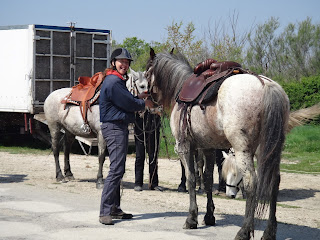 |
| Martins |
 |
Martins ridden by Benoit Colombet during a ferrade.
This horse is a rocket and is 'on the eye' in the bulls. |
The 18 years
young Arab is
the horse featured in the third abrivado in
the post called Abrivado & Bandido Continue.
It is another master cow horse. I could hardly believe its age when told.
This goes to show that an active being in mind and body keeps its spirit bright
and high.
 |
| 18 years old Arab, a very smooth ride and 'on the eye' in the bulls. |
3.5 years old is a newly
acquired horse by the manade. It was a great opportunity to ride a youngster in
the arena and outside. A nice horse with a lot of energy.
 |
| 3.5 years old |
12 years old
Camargue cow horse belongs to another manade where i was invited to ride in the bulls. Each
manade breeds a distinct shape type of Camargue depending on the lineage. This
horse was very stocky, with a strong back and croup. We were 10 gardians for
about 2 hours in the bulls and this horse just kept going in the mud like a
butterfly. It was a lovely feeling and another great opportunity to discover cow
work within another manade.
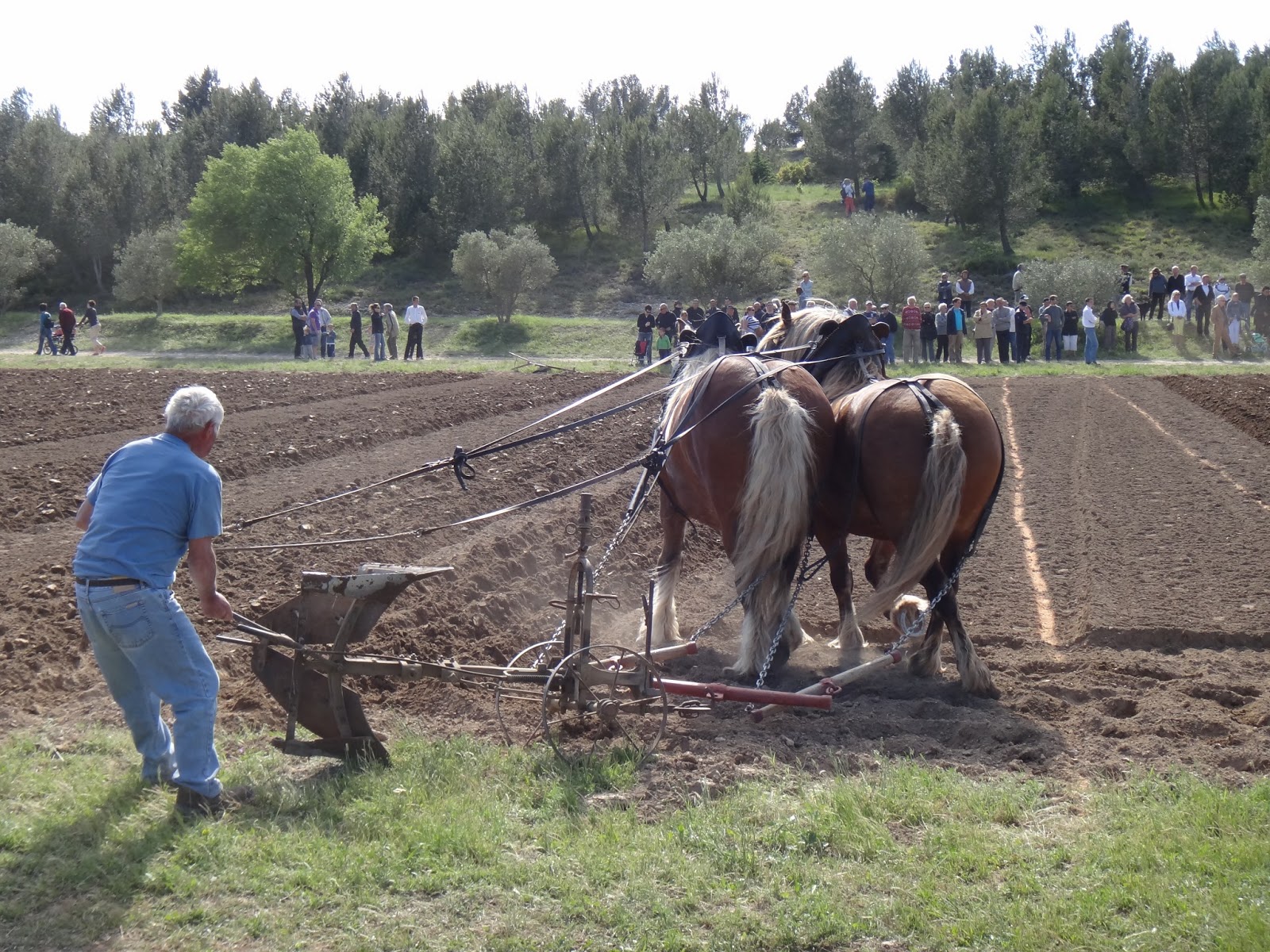
Rocket is Melanie’s
mare. It is a cross between a Percheron and a Trait Du Nord. She is driven and
ridden. She is a very sensitive horse, with surprising impulsion and a floating
trot. She could make a great 800kgs dressage sensation. Here are a few pictures
of us in the Alpilles.
.JPG) |
Hacking in the Alpilles.
Rocket is 800kgs of lightness. |
.JPG) |
| In front of Chapel Sixte, beautiful horse! |
Those
are all the horses i have ridden so far. There will be many more to come…keep
reading!


.JPG)


.JPG)




.JPG)
.JPG)